
A thinner Apple Watch Ultra 4 would be a regression.
With the alleged release of an Apple Watch Ultra 4 this Fall, it begs the question:
Should we expect a full redesign or just a more optimized watch like the 3 generations before it? No one knows, but if Apple does go the thinner route, that would be a huge step backwards in my opinion.
Everyone wants more battery life out of their Apple Watch, and people have even higher expectations with Apple Watch Ultra. The Ultra is branded and marketed as the ultimate sports and fitness tracker, and nothing matters more to athletes than great performance and better battery life. It’s already huge and bulky, so why try to make it a sleeker device when the regular Apple Watch does that very well?
Apple already trifurcated the Apple Watch lineup (SE, Series, Ultra), and have made each distinct from one another just like with iPhone 17, iPhone Air, and iPhone 17 Pro. The value-packed, budget Apple Watch SE is the iPhone 17, the thinner, sexier Apple Watch Series 11 is the iPhone Air, and Apple Watch Ultra is the iPhone 17 Pro - beefy, powerful, feature-rich, no holds barred.
I’m not asking for a thicker watch - just keep it the same thickness, and give us more battery life. Chips will inevitably get smaller, more powerful, and more efficient, leaving more space for battery. And for the love of God Apple, please fix the software experience. My Ultra 3 should not be more sluggish than my Series 10.
With the alleged release of an Apple Watch Ultra 4 this Fall, it begs the question:
Should we expect a full redesign or just a more optimized watch like the 3 generations before it? No one knows, but if Apple does go the thinner route, that would be a huge step backwards in my opinion.
Everyone wants more battery life out of their Apple Watch, and people have even higher expectations with Apple Watch Ultra. The Ultra is branded and marketed as the ultimate sports and fitness tracker, and nothing matters more to athletes than great performance and better battery life. It’s already huge and bulky, so why try to make it a sleeker device when the regular Apple Watch does that very well?
Apple already trifurcated the Apple Watch lineup (SE, Series, Ultra), and have made each distinct from one another just like with iPhone 17, iPhone Air, and iPhone 17 Pro. The value-packed, budget Apple Watch SE is the iPhone 17, the thinner, sexier Apple Watch Series 11 is the iPhone Air, and Apple Watch Ultra is the iPhone 17 Pro - beefy, powerful, feature-rich, no holds barred.
I’m not asking for a thicker watch - just keep it the same thickness, and give us more battery life. Chips will inevitably get smaller, more powerful, and more efficient, leaving more space for battery. And for the love of God Apple, please fix the software experience. My Ultra 3 should not be more sluggish than my Series 10.
Prime Day deals on Apple Watches, including sleeper deals on Titanium Series 10 models.
To be completely honest, the best Apple Watch version to get will be the Series 12 which will be released in 3 months, but if you must get an Apple Watch right now, you can’t go wrong with the Series 11 watches that are 25-30% off.
You can also get several Titanium Series 10 watches for $300 off which is insane considering they are the same as a Series 11, with the exception of no 5G connectivity. Upgrading to Titanium does get you increased durability and a luxurious experience as I mentioned previously.
Skip the Ultra 3 since there might be a redesigned and more powerful Ultra 4 in September.
Affiliate links:
Apple Watch Series 10 42mm Slate Titanium with Milanese Loop
To be completely honest, the best Apple Watch version to get will be the Series 12 which will be released in 3 months, but if you must get an Apple Watch right now, you can’t go wrong with the Series 11 watches that are 25-30% off.
You can also get several Titanium Series 10 watches for $300 off which is insane considering they are the same as a Series 11, with the exception of no 5G connectivity. Upgrading to Titanium does get you increased durability and a luxurious experience as I mentioned previously.
Skip the Ultra 3 since there might be a redesigned and more powerful Ultra 4 in September.
Affiliate links:
Apple Watch Series 10 42mm Slate Titanium with Milanese Loop
The 1st-generation Apple Watch Ultra was on the chopping block the day it was released because of its processor.
Although people are frustrated with the lack of support for watchOS 27 on older watches, you have to realize how Apple cycles its Apple Watch processor upgrades. Matt Popovich sums it up quite well:
Apple watch’s main upgrade happens every ~3 years whenever the processor (SiP = System in Package) gets upgraded:
~S4 SiP = Series 4, 5, SE
~S6 SiP = Series 6, 7, 8, SE2, Ultra
~S9 SiP = Series 9, 10, 11, SE3, Ultra 2, Ultra 3
Even though Apple has an S6, S7, and S8 SiP, each one of those have the same CPU and are thus basically the same chip, just renamed. So you won’t see much (if any) performance difference between them.
The takeaway from this is if you’re going to get, for example, a series 5, you’re better off getting a series 6. If you’re going to get a series 8, you’re better off getting a 9. It’s only a one year jump in watch but a ~3 year jump in processor. The processor will be faster and the watch will be supported with software updates for a few years longer.
Knowing these facts, the 1st-generation Ultra debuted with an S8 chip alongside the Series 8 and SE2, and doesn’t meet Apple’s performance standards for running watchOS 27 because it is an S6 chip at the end of the day. Think of it from this perspective - Apple Watch Ultra will be 4 years old this Fall, but its processor will be 6 years old.
The other thing to note is a new chip is released a year before Apple redesigns its mainstream Series numbered watch, starting with the S6 chip:
Faster S6 chip with Series 6 in 2020 - redesigned Series 7 watch in 2021
Faster S9 chip with Series 9 in 2023 - redesigned Series 10 watch in 2024
Faster S12 chip with Series 12 in 2026 - redesigned Series 13 watch in 2027
I like this pattern because each design of the Apple Watch ends its design cycle with the best possible processor at the time. Also note that the S10 chip in the Series 10 was followed by…an S10 chip in the Series 11 and Ultra 3. Apple didn’t even bother to rename the chip because it’s literally the same chip.
The S12 chip is only a prediction, but it makes perfect sense because Siri AI is going to be processor intensive, and Apple Watch needs an upgraded processor designed around Siri AI to sustain the next 3+ years of updates. The S9 and S10 chips are going to support Siri AI, but remember - Apple hasn’t shipped Siri AI for Apple Watch yet, nor demoed it, and currently Apple says it will be ready “later this year.”
I fully expect Apple to ship Siri AI on Apple Watch as promised since they don’t want to go through another Siri debacle, but if you want the best possible version of Siri AI, it will be on the next generation of watches.
Although people are frustrated with the lack of support for watchOS 27 on older watches, you have to realize how Apple cycles its Apple Watch processor upgrades. Matt Popovich sums it up quite well:
Apple watch’s main upgrade happens every ~3 years whenever the processor (SiP = System in Package) gets upgraded:
~S4 SiP = Series 4, 5, SE
~S6 SiP = Series 6, 7, 8, SE2, Ultra
~S9 SiP = Series 9, 10, 11, SE3, Ultra 2, Ultra 3
Even though Apple has an S6, S7, and S8 SiP, each one of those have the same CPU and are thus basically the same chip, just renamed. So you won’t see much (if any) performance difference between them.
The takeaway from this is if you’re going to get, for example, a series 5, you’re better off getting a series 6. If you’re going to get a series 8, you’re better off getting a 9. It’s only a one year jump in watch but a ~3 year jump in processor. The processor will be faster and the watch will be supported with software updates for a few years longer.
Knowing these facts, the 1st-generation Ultra debuted with an S8 chip alongside the Series 8 and SE2, and doesn’t meet Apple’s performance standards for running watchOS 27 because it is an S6 chip at the end of the day. Think of it from this perspective - Apple Watch Ultra will be 4 years old this Fall, but its processor will be 6 years old.
The other thing to note is a new chip is released a year before Apple redesigns its mainstream Series numbered watch, starting with the S6 chip:
Faster S6 chip with Series 6 in 2020 - redesigned Series 7 watch in 2021
Faster S9 chip with Series 9 in 2023 - redesigned Series 10 watch in 2024
Faster S12 chip with Series 12 in 2026 - redesigned Series 13 watch in 2027
I like this pattern because each design of the Apple Watch ends its design cycle with the best possible processor at the time. Also note that the S10 chip in the Series 10 was followed by…an S10 chip in the Series 11 and Ultra 3. Apple didn’t even bother to rename the chip because it’s literally the same chip.
The S12 chip is only a prediction, but it makes perfect sense because Siri AI is going to be processor intensive, and Apple Watch needs an upgraded processor designed around Siri AI to sustain the next 3+ years of updates. The S9 and S10 chips are going to support Siri AI, but remember - Apple hasn’t shipped Siri AI for Apple Watch yet, nor demoed it, and currently Apple says it will be ready “later this year.”
I fully expect Apple to ship Siri AI on Apple Watch as promised since they don’t want to go through another Siri debacle, but if you want the best possible version of Siri AI, it will be on the next generation of watches.
Apple Watch ultimate comparison chart.
Apple only allows you to compare 3 watches side-by-side, but if you really want to compare more watches together with more detail, check out this extremely detailed spreadsheet by Matt Popovich.
I was wondering how on line 40 he got those numbers for estimated processor performance, but what he did was take Apple’s typical statement from each keynote where the new processor is up to whatever percent faster than the previous generation, and just did the math.
One correction though - the S1P and S2 chip had the same processor speed, so the math leading to the current S10 chip would make the S10 chip up to 8x faster than the original Apple Watch, not 12x.
Apple only allows you to compare 3 watches side-by-side, but if you really want to compare more watches together with more detail, check out this extremely detailed spreadsheet by Matt Popovich.
I was wondering how on line 40 he got those numbers for estimated processor performance, but what he did was take Apple’s typical statement from each keynote where the new processor is up to whatever percent faster than the previous generation, and just did the math.
One correction though - the S1P and S2 chip had the same processor speed, so the math leading to the current S10 chip would make the S10 chip up to 8x faster than the original Apple Watch, not 12x.
Apple Watch shows you the disconnected, “red iPhone of death” in more places in watchOS 27.
I only saw it once, but I got receipts. When I went inside of my Messages app, I noticed the disconnected iPhone logo (aka the red iPhone of death). I opened multiple apps, and I saw the same logo next to the time. Looks like Apple did make it more prominent than before. Previously, the only way to see your iPhone connection status was in Control Center. In ancient times, it was on the watch face itself which is what I want, but this is a step in the right direction.
I couldn’t replicate this experience no matter what I did, and now it only shows the “red iPhone of death” in Control Center. Weird, but we’re still in Developer Beta 1 so I’m optimistic (my previous rant can be read here).
I only saw it once, but I got receipts. When I went inside of my Messages app, I noticed the disconnected iPhone logo (aka the red iPhone of death). I opened multiple apps, and I saw the same logo next to the time. Looks like Apple did make it more prominent than before. Previously, the only way to see your iPhone connection status was in Control Center. In ancient times, it was on the watch face itself which is what I want, but this is a step in the right direction.
I couldn’t replicate this experience no matter what I did, and now it only shows the “red iPhone of death” in Control Center. Weird, but we’re still in Developer Beta 1 so I’m optimistic (my previous rant can be read here).
Slate Titanium vs Jet Black Aluminum Apple Watch - which one should you buy?
The answer might be obvious from a budget perspective since the Jet Black is $300 cheaper than the Slate Titanium, but you have to consider the following 5 factors:
Durability
Luxury appeal
Screen quality
Pricing
Durability
There’s no question both finishes can get scratched and show the natural aluminum or titanium color, but Jet Black will definitely show the aluminum more prominently due to its darker “Jet Blackness.” Slate Titanium is lighter, making it more likely to mask any scratches. Aluminum is also softer, so it will dent with hard impacts. Neither finish can be buffed or polished since it will remove the coating, leaving bare metal.
Luxury Appeal
Both have a nice, unique sheen to them and even though Jet Black is a great piece that can do both sport and luxury, the Slate Titanium really takes the win with matching luxury bands that don’t disrupt the flow of the lighter Titanium sheen. The Jet Black reminds me a lot of Space Black - very stealth, but the coating is so dark that it can quickly look dull from skin oils, requiring frequent wiping.
Screen Quality
It’s a double-edged sword, but the Titanium Apple Watches have a sapphire display, making them 100% scratch-proof unless you happen to rub your watch against diamonds. The caveat here is sapphire displays are more likely to crack on impact. For the Jet Black Aluminum (and all aluminum Apple Watches), Apple uses an Ion-X glass display, which is less likely to shatter on impact, but much more likely to get scratched.
I have been wearing Apple watches daily since 2015, and from my personal experience of owning over a dozen watches, every single Apple Watch with an Ion-X glass has gotten scratched, and not a single Apple Watch with a Sapphire display ever got a scratch or a crack. The Ion-X glass is objectively inferior and can easily go from pristine to a scratched mess if you’re not careful.
Pricing
You can get a Slate Titanium Series 10 at deep discounts since it's almost two years old while having the same processing power as the Series 11. The only difference is the Series 11 has 5G instead of LTE. More importantly, both will support the new Siri AI.
I sold my Jet Black aluminum because I was able to snag a Series 10 in Slate Titanium with Milanese Loop for $449 vs a Series 11 at $749, saving $300. Once again, the only real difference being LTE vs 5G. I don't even use a cellular plan on my Apple Watch so this was a non-factor.
If you plan on keeping your watch for years on end and don’t want to worry about a scratched display, the Titanium models are the way to go. The premium is worth it for the look, feel, and durability.
Photos
Here’s some side-by-side shots of the Jet Black vs the Slate Titanium. I also have a regular Stainless Steel model Series 9 just for comparison since Slate compared to Jet Black might look like Silver. 📸
The answer might be obvious from a budget perspective since the Jet Black is $300 cheaper than the Slate Titanium, but you have to consider the following 5 factors:
Durability
Luxury appeal
Screen quality
Pricing
Durability
There’s no question both finishes can get scratched and show the natural aluminum or titanium color, but Jet Black will definitely show the aluminum more prominently due to its darker “Jet Blackness.” Slate Titanium is lighter, making it more likely to mask any scratches. Aluminum is also softer, so it will dent with hard impacts. Neither finish can be buffed or polished since it will remove the coating, leaving bare metal.
Luxury Appeal
Both have a nice, unique sheen to them and even though Jet Black is a great piece that can do both sport and luxury, the Slate Titanium really takes the win with matching luxury bands that don’t disrupt the flow of the lighter Titanium sheen. The Jet Black reminds me a lot of Space Black - very stealth, but the coating is so dark that it can quickly look dull from skin oils, requiring frequent wiping.
Screen Quality
It’s a double-edged sword, but the Titanium Apple Watches have a sapphire display, making them 100% scratch-proof unless you happen to rub your watch against diamonds. The caveat here is sapphire displays are more likely to crack on impact. For the Jet Black Aluminum (and all aluminum Apple Watches), Apple uses an Ion-X glass display, which is less likely to shatter on impact, but much more likely to get scratched.
I have been wearing Apple watches daily since 2015, and from my personal experience of owning over a dozen watches, every single Apple Watch with an Ion-X glass has gotten scratched, and not a single Apple Watch with a Sapphire display ever got a scratch or a crack. The Ion-X glass is objectively inferior and can easily go from pristine to a scratched mess if you’re not careful.
Pricing
You can get a Slate Titanium Series 10 at deep discounts since it's almost two years old while having the same processing power as the Series 11. The only difference is the Series 11 has 5G instead of LTE. More importantly, both will support the new Siri AI.
I sold my Jet Black aluminum because I was able to snag a Series 10 in Slate Titanium with Milanese Loop for $449 vs a Series 11 at $749, saving $300. Once again, the only real difference being LTE vs 5G. I don't even use a cellular plan on my Apple Watch so this was a non-factor.
If you plan on keeping your watch for years on end and don’t want to worry about a scratched display, the Titanium models are the way to go. The premium is worth it for the look, feel, and durability.
Photos
Here’s some side-by-side shots of the Jet Black vs the Slate Titanium. I also have a regular Stainless Steel model Series 9 just for comparison since Slate compared to Jet Black might look like Silver.

From left to right: Jet Black Aluminum, Slate Titanium, Stainless Steel. All 3 look gorgeous in their own way.

Jet Black almost disappears in darker lighting, even though it is the same size as the Slate Titanium.

Speaker side angle - notice how Slate almost looks Silver with bright lighting.

Once again the screen disappears into the Jet Black chassis (left) compared to Slate (middle).

Closer detail between screen and chassis.

Digital Crown up close. Notice the difference in the knurling with the Stainless Steel Series 9 vs the other two Series 10 watches.
Weird but cool glitch on the Chronograph Pro watch face.
It’s just much easier to watch a video on this instead of me trying to explain it with words, but I will say:
Dear Apple, please turn this glitch into a feature.
I sold my Jet Black Apple Watch and got a great deal on a Slate Titanium Series 10.
After gawking at this watch for over a year and singing its praises, it was time for a change. Trying to baby the Jet Black watch and trying to keep the screen scratch free only led to exactly that - a scratched screen. How it happened I couldn’t tell you, but it was time to let it go. I’m just glad it went to a grandma who is going to use it for Fall Detection and other health features.
I never intended to sell the watch, but when a crazy deal comes your way, you take it. Amazon was selling the Series 10 in Slate Titanium with Milanese Loop for only $450 instead of the usual $750. I jumped on the deal, and even for someone who has a lot of Apple watches it was a bit ludicrous to have 2 Series 10 models.
The Series 10 with the sapphire display has only one difference compared to the Series 11, and that is it “only” supports LTE instead of 5G. I don’t use a data plan on my watch, so I had zero desire for a Series 11.
Slate Titanium isn’t as dark as Jet Black, but it has its own appeal that I am happy with - and best of all, a screen that won’t scratch.
After gawking at this watch for over a year and singing its praises, it was time for a change. Trying to baby the Jet Black watch and trying to keep the screen scratch free only led to exactly that - a scratched screen. How it happened I couldn’t tell you, but it was time to let it go. I’m just glad it went to a grandma who is going to use it for Fall Detection and other health features.
I never intended to sell the watch, but when a crazy deal comes your way, you take it. Amazon was selling the Series 10 in Slate Titanium with Milanese Loop for only $450 instead of the usual $750. I jumped on the deal, and even for someone who has a lot of Apple watches it was a bit ludicrous to have 2 Series 10 models.
The Series 10 with the sapphire display has only one difference compared to the Series 11, and that is it “only” supports LTE instead of 5G. I don’t use a data plan on my watch, so I had zero desire for a Series 11.
Slate Titanium isn’t as dark as Jet Black, but it has its own appeal that I am happy with - and best of all, a screen that won’t scratch.
Apple Watch improvements I would like to see in watchOS 27.
WWDC is right around the corner, and there are quite a few Apple Watch niggles that need to be addressed. The good thing is this year has been unofficially dubbed, “the year of stability” for Apple software releases, and Apple Watch is definitely in need of stability and improvements. I’ve discussed them in detail in the past, but I’ll link all my wish list items below:
1. Smoother Swipe to Switch Watch Face
Still a broken experience that needs to go back to its watchOS 8 roots. You can see the difference between watchOS 8 and watchOS 10 onwards. It still looks like a beta feature in its current state. Notice how the time in watchOS 8 stays in sync and doesn’t have to refresh every, single, time you switch watch faces.
2. Dynamic watch face complications that utilize the 1 Hz refresh rate of the display
From a previous post:
To complicate things further, there are plenty of complications such as the digital time and digital seconds complications that would make this feature pop even more on the watch. Your always on display would look more realistic, with ticking “components” constantly updating every second without sacrificing battery life. That “magical” touch would sell more watches, because we are visual creatures, and to see the Apple Watch acting like an actual watch that ticks and doesn’t stop moving will blur the line between digital and traditional watch faces.
Watch enthusiasts will appreciate it even more, and won’t scoff (as much) at us digital watch wearers. They will still scoff at us when they notice its quartz-like movement, but appreciate the technological step forward and will purchase one, probably a more expensive model to boot.
3. A more apparent “Apple Watch is disconnected from your phone” icon.
Dear Apple, watchOS 8 would let us know immediately when our iPhone was disconnected from the watch - please bring that back.
4. General stability
My Ultra 3 and Series 10 are very slow and have slow frame rates when going into Control Center and when using the Digital Crown to scroll rapidly between watch faces. This is more apparent on my Ultra 3 even though I set it up from scratch to see if that would fix it, to no avail. Why is the experience on my Series 5, released almost 7 years ago, smoother than a brand new “Ultra” watch?
5. Better watch face representation in Smart Stack
All new watch faces in the last 2 years have had this update and older watch faces would benefit.
WWDC is right around the corner, and there are quite a few Apple Watch niggles that need to be addressed. The good thing is this year has been unofficially dubbed, “the year of stability” for Apple software releases, and Apple Watch is definitely in need of stability and improvements. I’ve discussed them in detail in the past, but I’ll link all my wish list items below:
1. Smoother Swipe to Switch Watch Face
Still a broken experience that needs to go back to its watchOS 8 roots. You can see the difference between watchOS 8 and watchOS 10 onwards. It still looks like a beta feature in its current state. Notice how the time in watchOS 8 stays in sync and doesn’t have to refresh every, single, time you switch watch faces.
2. Dynamic watch face complications that utilize the 1 Hz refresh rate of the display
From a previous post:
To complicate things further, there are plenty of complications such as the digital time and digital seconds complications that would make this feature pop even more on the watch. Your always on display would look more realistic, with ticking “components” constantly updating every second without sacrificing battery life. That “magical” touch would sell more watches, because we are visual creatures, and to see the Apple Watch acting like an actual watch that ticks and doesn’t stop moving will blur the line between digital and traditional watch faces.
Watch enthusiasts will appreciate it even more, and won’t scoff (as much) at us digital watch wearers. They will still scoff at us when they notice its quartz-like movement, but appreciate the technological step forward and will purchase one, probably a more expensive model to boot.
3. A more apparent “Apple Watch is disconnected from your phone” icon.
Dear Apple, watchOS 8 would let us know immediately when our iPhone was disconnected from the watch - please bring that back.
4. General stability
My Ultra 3 and Series 10 are very slow and have slow frame rates when going into Control Center and when using the Digital Crown to scroll rapidly between watch faces. This is more apparent on my Ultra 3 even though I set it up from scratch to see if that would fix it, to no avail. Why is the experience on my Series 5, released almost 7 years ago, smoother than a brand new “Ultra” watch?
5. Better watch face representation in Smart Stack
All new watch faces in the last 2 years have had this update and older watch faces would benefit.
Apple Watch independence for all?
Imthaz over at Volatile Inputs talking about his WWDC 2026 wishlist, ending with a banger:
The third thing is Apple Watch independence. Apple still considers the Watch an accessory to the iPhone, just like AirPods. But AirPods are not stuck to one device — you actually don’t even need an iPhone to use them. The Watch still doesn’t work that way. Last year I spent a while with an iPhone 13 Mini. The camera is what eventually pushed me away from it, but even when I considered carrying two phones, the Apple Watch killed the idea. It syncs to one phone. When I go to the gym I want a smaller device that keeps me connected. When I’m out, I want the best camera I can carry. Either the Watch intelligently switches between iPhones, or there should be something in Control Centre where you can pick which iPhone it’s paired to, the same way you switch audio output for AirPods. […]
Apple has the hardware and the ecosystem, the software just has to catch up.
I would love this feature, and to add to this, Apple Watch should also have Continuity with iPad showing you workout metrics like it does on iPhone. Sometimes you just need your iPad and your watch when working out and monitoring your metrics would be better on a bigger display while you catchup on some YouTube.
Imthaz over at Volatile Inputs talking about his WWDC 2026 wishlist, ending with a banger:
The third thing is Apple Watch independence. Apple still considers the Watch an accessory to the iPhone, just like AirPods. But AirPods are not stuck to one device — you actually don’t even need an iPhone to use them. The Watch still doesn’t work that way. Last year I spent a while with an iPhone 13 Mini. The camera is what eventually pushed me away from it, but even when I considered carrying two phones, the Apple Watch killed the idea. It syncs to one phone. When I go to the gym I want a smaller device that keeps me connected. When I’m out, I want the best camera I can carry. Either the Watch intelligently switches between iPhones, or there should be something in Control Centre where you can pick which iPhone it’s paired to, the same way you switch audio output for AirPods. […]
Apple has the hardware and the ecosystem, the software just has to catch up.
I would love this feature, and to add to this, Apple Watch should also have Continuity with iPad showing you workout metrics like it does on iPhone. Sometimes you just need your iPad and your watch when working out and monitoring your metrics would be better on a bigger display while you catchup on some YouTube.
Modular Ultra watch face - how does it look on a regular Apple Watch?
I took some screenshots on my Apple Watch Ultra, put them on my regular Apple Watches, and I’m really impressed with how the Modular Ultra face looks and scales. When you choose the large time, the complications are the same size as the Modular watch face as discussed near the end of my previous piece, so you won’t notice a difference unless you use the bezel complication.
You can try it yourself with this process:
Save photos (linked below) to the Photos app and mark them as Favorite.
On Apple Watch, open the Photos app and scroll to Favorites.
Select the image and use the digital crown to fit the image to your display.
Images:
Here are photos using the smaller 40mm, 41mm, and 42mm Apple Watch sizes being sold today. 📓
I took some screenshots on my Apple Watch Ultra, put them on my regular Apple Watches, and I’m really impressed with how the Modular Ultra face looks and scales. When you choose the large time, the complications are the same size as the Modular watch face as discussed near the end of my previous piece, so you won’t notice a difference unless you use the bezel complication.
You can try it yourself with this process:
Save photos (linked below) to the Photos app and mark them as Favorite.
On Apple Watch, open the Photos app and scroll to Favorites.
Select the image and use the digital crown to fit the image to your display.
Images:
Here are photos using the smaller 40mm, 41mm, and 42mm Apple Watch sizes being sold today.

40mm Apple Watch Series 5 Ceramic - this is the same size as the current 3rd generation Apple Watch SE.

Retro analog nostalgia with this 41mm Apple Watch Series 9 - even on the smaller size, a maxed out Modular Ultra watch face is doable, but…

I prefer the large time with 6 complications to keep it simple.

42mm Series 10 in Slate Titanium. The complications do get pushed closer together when the bezel complication is active.

42mm Series 10 in Slate Titanium.
The Modular Ultra watch face would be an upgrade for regular Apple Watch users, even when downgraded.
A new watch face for the standard Apple Watch that mimics the theme of the Modular Ultra watch face may be headed our way. From Mark Gurman’s Power On Newsletter a few weeks ago (quoted from MacRumors):
It has the same large clock as the Ultra face but removes the option for a big complication in the center, the row of three smaller complications above the time and information placed around the bezel. The result is a large clock that fills the top two-thirds of the display, with a row of three smaller complications beneath it.
Sounds unique, but a more useful watch face would be…📓
A new watch face for the standard Apple Watch that mimics the theme of the Modular Ultra watch face may be headed our way. From Mark Gurman’s Power On Newsletter a few weeks ago (quoted from MacRumors):
It has the same large clock as the Ultra face but removes the option for a big complication in the center, the row of three smaller complications above the time and information placed around the bezel. The result is a large clock that fills the top two-thirds of the display, with a row of three smaller complications beneath it.
Sounds unique, but a more useful watch face would be the Modular Ultra watch face the way it is.
Just keep it simple.
Most regular users will be delighted to have it since they probably don’t know about this watch face, and power users who prefer the more compact Apple Watches will also appreciate it.
It’s a win-win.
Having a maxed out Modular Ultra watch face does make things more claustrophobic, but the beauty is you can customize it how you want. If you can’t read the fine print, you can go bezel-less with the big time. If you have hawk eyes and can read the fine print, then more power to you.
Either way, it can’t be worse than the Photos watch face:
Let’s say Apple does decide to downgrade the Modular Ultra for the normies and calls it “Modular Pro.” This watch face should have:
6 circle complications.
One clock size option (large time with or without seconds).
No bezel complication.
Apple’s current Modular watch face has 6 complications, but only 5 of them are truly customizable while the 6th one is destined to be a ‘date’ complication. That ‘date’ complication takes up a whole row of pixels that could easily allow space for um, you know, 3 more complications.

Getting rid of the date complication on top would allow for 3 more complications and still plenty of space for a large digital clock.
If you remove the bezel complication, the circle complications will be the same size as those on the Modular face, making size a non-issue.

Notice how the 3 complications on the bottom grow in size when you remove the bezel complication (middle). The complications are more spaced out as well, but not as much as the standard Modular complications (right).

All of the different clock size options for Modular Ultra. The two middle options are a perfect upgrade for a new “Modular Pro” watch face.
More Zenith font in Apple Watch Ultra please.
Interesting experiment from David Smith, developer of Widgetsmith, who created his own custom fonts for his Apple Watch Ultra complications. He wanted to match the aesthetic of the Ultra’s signature font referred to as Zenith.
It’s a nice, oxymoronic, minimalist Modular Ultra watch face.
Interesting experiment from David Smith, developer of Widgetsmith, who created his own custom fonts for his Apple Watch Ultra complications. He wanted to match the aesthetic of the Ultra’s signature font referred to as Zenith.
It’s a nice, oxymoronic, minimalist Modular Ultra watch face.
The original Mickey Mouse watch face - one of the most influential watches ever?
Many watch enthusiasts would argue against this, but you can see where Apple got its influence for the Mickey Mouse watch face. The origin story for this watch has, “Steve Jobs coming back to Apple” vibes.
From Esquire:
In 1933, two companies faced bankruptcy. One was Ingersoll-Waterbury, a watch firm that grew out of a New York Mail business. The other was Disney. A marketeer and former mink-hat salesman named Herman “Kay” Kamen rescued both — despite apparently falling asleep in the pitch meeting. His solution? A watch featuring Mickey Mouse, his yellow-gloved hands rotating to tell the time. Response to the $3.75 timepiece was immediate. Macy’s sold 11,000 the first day it went on sale, and within two years Ingersoll had added 2,800 staff to cope with demand, and an original Ingersoll Mickey was placed into a time capsule at the 1939 World’s Fair. Today, “character watches” are big news; case in point: Oris’ runaway 2023 hit, a £3,700 watch featuring Kermit the Frog. Meanwhile Mickey (and Minnie) Mouse now grace the Apple Watch and will speak the time when you press the dial. That’s progress for you.
Many watch enthusiasts would argue against this, but you can see where Apple got its influence for the Mickey Mouse watch face. The origin story for this watch has, “Steve Jobs coming back to Apple” vibes.
From Esquire:
In 1933, two companies faced bankruptcy. One was Ingersoll-Waterbury, a watch firm that grew out of a New York Mail business. The other was Disney. A marketeer and former mink-hat salesman named Herman “Kay” Kamen rescued both — despite apparently falling asleep in the pitch meeting. His solution? A watch featuring Mickey Mouse, his yellow-gloved hands rotating to tell the time. Response to the $3.75 timepiece was immediate. Macy’s sold 11,000 the first day it went on sale, and within two years Ingersoll had added 2,800 staff to cope with demand, and an original Ingersoll Mickey was placed into a time capsule at the 1939 World’s Fair. Today, “character watches” are big news; case in point: Oris’ runaway 2023 hit, a £3,700 watch featuring Kermit the Frog. Meanwhile Mickey (and Minnie) Mouse now grace the Apple Watch and will speak the time when you press the dial. That’s progress for you.
I saw a Series 3 Apple Watch in the wild before I saw an iPhone Air in the wild.
An older nurse was wearing it while we were in the hospital, and I’m assuming it was a Series 3. It could have been a Series 2 or older, but either way it’s pretty cool to see an almost 10 year old Apple Watch being used in 2026.
It was the 38mm variant and of course she had the best Apple Watch face…📓
An older nurse was wearing it while we were in the hospital, and I’m assuming it was a Series 3. It could have been a Series 2 or older, but either way it’s pretty cool to see an almost 10 year old Apple Watch being used in 2026.
It was the 38mm variant and of course she had the best Apple Watch face - Utility.
The straight-line text on her complications was a dead giveaway that it was the first-generation body. The straight-text complications look great on the more squared off body, but it was a necessity since the screen was much smaller than what the dimensions of the watch would assume.

Series 3 42mm versus Series 10 42mm.
42mm was the large size when the Series 3 was released, and now 42mm is the smaller Apple watch size.
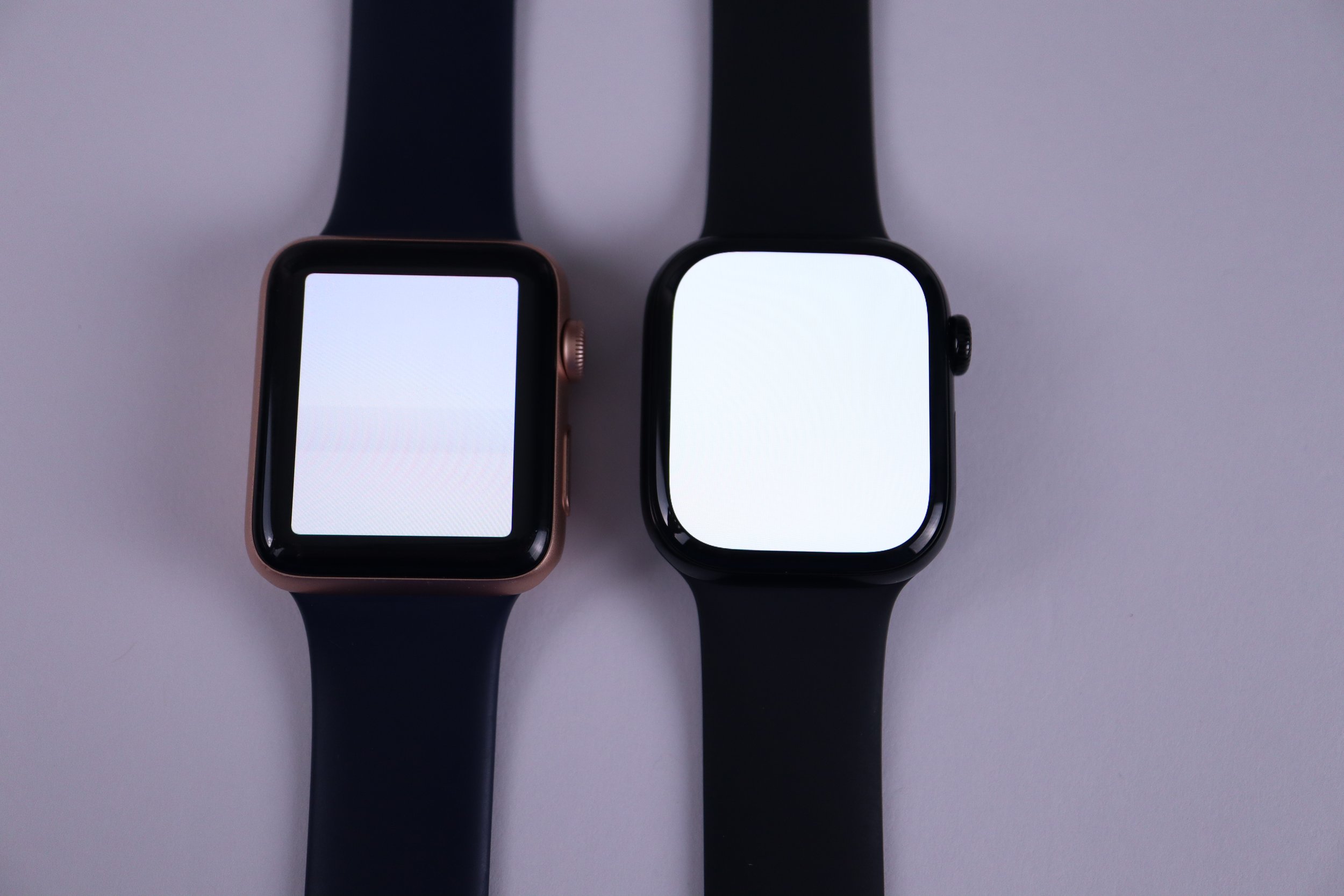


The screen to body ratio has changed dramatically from the 1st generation design to the 4th generation design.
Buying a Milanese Loop for your aluminum Apple Watch? Think twice.
Milanese Loops are great, until they aren’t.
If you own an aluminum Apple Watch, the Milanese Loop can work with it, sometimes really well like in this Space Gray example, but you have to know its limitations.
The Milanese Loop is made out of stainless steel or Titanium, and both materials scratch glass. Technically the Titanium Milanese Loop shouldn’t scratch glass since it has a lower hardness than glass, but it could scratch the glass indirectly if there’s grit stuck in between the crevices and the silica rubs against the glass. I had a horrible experience in the past where my stainless steel Milanese Loop created scratches in a hashtag-like pattern on my aluminum Apple Watch display back in 2015.
I put my watch in my pocket when using an airplane bathroom and didn’t want to wash my hands while wearing the watch. This was when Apple Watches were not officially water resistant, so I didn’t want to take any chances. Funny thing is I would have been better off wearing the watch while washing my hands to avoid what was to come…
I came out of the bathroom and held my daughter on my lap, and she was naturally bouncing around on my lap like any 3-year old would. The watch was still in my pocket (I forgot all about it), directly underneath her bottom, and it was getting pummeled unbeknownst to me as she was squirming around. In the end the Milanese Loop left the hashtag pattern of scratches on the display which is why I avoid aluminum Apple Watches altogether. I made an exception for Jet Black last year, but I knew not to wear a Milanese Loop with it, nor put it in my pocket.
If you do choose to get a Milanese Loop for an aluminum Apple Watch, be extra careful and don’t allow the band to sit on the glass. This is not a problem if you get a Stainless Steel or Titanium Apple Watch since the display is made of sapphire.
Milanese Loops are great, until they aren’t.
If you own an aluminum Apple Watch, the Milanese Loop can work with it, sometimes really well like in this Space Gray example, but you have to know its limitations.
The Milanese Loop is made out of stainless steel or Titanium, and both materials scratch glass. Technically the Titanium Milanese Loop shouldn’t scratch glass since it has a lower hardness than glass, but it could scratch the glass indirectly if there’s grit stuck in between the crevices and the silica rubs against the glass. I had a horrible experience in the past where my stainless steel Milanese Loop created scratches in a hashtag-like pattern on my aluminum Apple Watch display back in 2015.
I put my watch in my pocket when using an airplane bathroom and didn’t want to wash my hands while wearing the watch. This was when Apple Watches were not officially water resistant, so I didn’t want to take any chances. Funny thing is I would have been better off wearing the watch while washing my hands to avoid what was to come…
I came out of the bathroom and held my daughter on my lap, and she was naturally bouncing around on my lap like any 3-year old would. The watch was still in my pocket (I forgot all about it), directly underneath her bottom, and it was getting pummeled unbeknownst to me as she was squirming around. In the end the Milanese Loop left the hashtag pattern of scratches on the display which is why I avoid aluminum Apple Watches altogether. I made an exception for Jet Black last year, but I knew not to wear a Milanese Loop with it, nor put it in my pocket.
If you do choose to get a Milanese Loop for an aluminum Apple Watch, be extra careful and don’t allow the band to sit on the glass. This is not a problem if you get a Stainless Steel or Titanium Apple Watch since the display is made of sapphire.
How to share your Apple Watch face with others.
After yesterday’s advice, it only seems right to explain how to share your watch face with others:
Go to the Watch app.
Select the watch face you want to share.

After yesterday’s advice, it only seems right to explain how to share your watch face with others:
- Go to the Watch app.
- Select the watch face you want to share.
- Click on the Share icon.
Maybe there is a way you can save your favorite Apple Watch face from being eliminated?
With watchOS 11, Apple discontinued several watch faces, the most notable one being the Explorer watch face. The cancelling continued with watchOS 26, with more (admittedly worth cancelling) watch faces that got burned and bit the dust. I’m not sure how Apple decides what faces to discontinue, but it has to be based on user preference. Apple has a ton of data on what Apple Watches are active, and they must know what watch faces are actively being used. There is probably a different metric for a watch face being active on your display, vs a watch face that is in your carousel of watch faces but isn’t actively being used. You made the watch face, but it rarely becomes your active watch face.
My guess is if you really want a particular Apple Watch face to live another year, make sure you’re actively using that watch face. If you want to go beyond the call of duty, you can share and promote that watch face to your friends, family, and even foes. The more people using it, the less likely it will be discontinued (at least that’s my theory).
In that regard, I’m evangelizing the Motion Watch face with the beautiful Jellyfish.
With watchOS 11, Apple discontinued several watch faces, the most notable one being the Explorer watch face. The cancelling continued with watchOS 26, with more (admittedly worth cancelling) watch faces that got burned and bit the dust. I’m not sure how Apple decides what faces to discontinue, but it has to be based on user preference. Apple has a ton of data on what Apple Watches are active, and they must know what watch faces are actively being used. There is probably a different metric for a watch face being active on your display, vs a watch face that is in your carousel of watch faces but isn’t actively being used. You made the watch face, but it rarely becomes your active watch face.
My guess is if you really want a particular Apple Watch face to live another year, make sure you’re actively using that watch face. If you want to go beyond the call of duty, you can share and promote that watch face to your friends, family, and even foes. The more people using it, the less likely it will be discontinued (at least that’s my theory).
In that regard, I’m evangelizing the Motion Watch face with the beautiful Jellyfish.
watchOS 27 feature request: more triple, bite-sized widgets in Smart Stack please.
Smart Stack is great, but it becomes a drag to scroll through all your widgets when you just need a lot of different info as quick as possible. I love the default triple widget, but can we get more than one as an option? I know it will eat into my total widget count, but I’m OK with 6 of my 10 widgets being tied up into 2 blocks.
There are other triple widgets such as alarms, messages, and even the weather widget, but I want the truly independent triple widget that is not a subset of a particular app. Ideally I would like 2 triple widgets that have the following:

Messages
Digital seconds
Prayer timings
Activity Rings
Alarms
Start a Workout
Smart Stack is great, but it becomes a drag to scroll through all your widgets when you just need a lot of different, small bits of information as quick as possible. I love the default triple widget, but can we get more than one as an option? I know it will eat into my total widget count, but I’m OK with 6 of my 10 widgets being tied up into 2 blocks.
There are other triple widgets such as alarms, messages, and even the weather widget, but I want the truly independent triple widget that is not a subset of a particular app. My 2 triple widget setup would look like this:
Messages
Digital seconds
Weather temperature
Activity Rings
Prayer timings
Start a Workout
Apple shows off rare prototypes to the Wall Street Journal.
Nice little video with Tim Cook and Ben Cohen from the Wall Street Journal talking about key moments in Apple’s history, showing some rare prototypes, and, “one more thing” from the Wall Street Journal for Tim Cook. Worth a watch.
Nice little video with Tim Cook and Ben Cohen from the Wall Street Journal talking about key moments in Apple’s history, showing some rare prototypes, and, “one more thing” from the Wall Street Journal for Tim Cook. Worth a watch.